Preserving the History of the Hiram M. Chittenden Locks in Seattle, Washington

Contact us at friendsofthelocks@gmail.com

Monday, May 24, 2010

Spring Cleaning: Preparing the Fish Ladder for Salmon!

We're spring cleaning & getting ready for guests--the salmon are coming!

The fish ladder at the Chittenden Locks will be closed May 24-June 4 for annual cleaning, inspection and maintenance; the fish viewing gallery will be closed to the public during this time.

There actually was a fish ladder constructed in 1917 with the spillway dam; it was very primitive as we didn't know much about salmon migration in those days. The ladder was not very effective and many salmon moved upstream through the locks and were injured by boats and propellers or by hitting the barnacle-encrusted walls and gates.

In 1976 the Corps of Engineers completely rebuilt the ladder, increasing the number of weirs (steps, or waterfalls) from 10 to 21, and increasing the flow of water. The rush of water out of the base of the ladder attracts the salmon away from the locks, as salmon instinctively know to go against the flow to trace their way back to their natal stream. The smell and taste of their home stream in genetically imprinted while they are young and they follow that unique smell/taste back upstream to spawn.

Moving quickly up the waterfalls the salmon jump each step or swim through tunnel-like openings between each weir. Weir 18 of the ladder was elongated to make the fish viewing gallery possible; here the salmon often spend a few hours resting and acclimating to fresh water before continuing their journey upstream.

The sockeye salmon is the first salmon species to return to the Lake Washington Ship Canal each year, the early ones usually show up around mid-June and the run normally peaks in early July. The word sockeye is a corruption of "sukkai", the name for the fish used by the Native Peoples of southern British Columbia.

Chinook (king) and Coho (silver) salmon runs follow during the summer months.


Check back often for more information and updates on the salmon runs at the Chittenden Locks!


All photos courtesy of USACE/Historical Collection Lake Washington Ship Canal

Monday, April 26, 2010

Opening Day of Boating Season!

1978

Wow! It’s hard to believe that Opening Day of boating season is just around the corner.

Traditionally, opening day is celebrated on the first Saturday in May. In 2010, that's this coming Saturday, May 1. However, you'll see boat traffic through the locks increase all week as boaters make their way to the lakes & ship canal.

Seattle has a rich maritime tradition; opening day is to boating what robins are to spring.

Now is the time to pull your boat out and get it ready for another exciting season on the water. If you visit the locks you’re sure to see hundreds of boats making the passage.

2009

Many of these boats are on their way to cheer on their favorite team at the Windermere Cup races held in the Montlake Cut. If you’ve never experienced this special day you should make plans. It’s hard to imagine a better place to see a race up close where you can see the strain as each rower gives their all.

Below is a slideshow of some pictures of boats through the locks and ship canal.


Saturday, April 17, 2010

Smoltificatious!

Ever wonder what those big white metal tubes were on the spillway dam at the Locks? Read on.

The Corps of Engineers has installed those tubes; they are smolt flumes designed to help juvenile salmon safely bypass the Locks on their migration out to the ocean.

Studies had shown that smolts (juvenile salmon) were having a difficult time going through the Locks, which is their only passageway from the Lake Washington basin out to Puget Sound. Fish would get injured or killed when pulled into the filling tunnels or going over the spillway dam. In 1995 a prototype flume was installed to determine their feasibility, when deemed successful the current models were built at the Puget Sound Naval Shipyard and installed in May 2000.

The 4 flumes are different sizes to better regulate the outflow of water from the freshwater lakes. The narrow outer ends of the tubes contain an electronic screen to read the PIT tags that are implanted in some of the smolts. PIT is "passive integrated transponder," a microchip type of tracking device.

Standing on the spillway dam late April to early July you may see dozens of small (4"-6") fish shooting out of the flumes with the water, these are the sockeye, chinook and coho smolts headed out to the ocean. What looks to us like a dizzying fall is "just another waterfall" to a smolt and is actually safer than going through the Locks. The cords strung across the spill basin help increase smolt survival by detering seagulls from diving down to feast on the young fish. The smolts remain in the lower basin area for a few weeks acclimating, feeding and growing before they continue their journey to the Pacific.

The term smolt comes from the word "smoltification" which is the biological process the juvenile fish go through which enables them to make the transition from fresh to salt water.


Note: The fish ladder will be closed June 1-11 for its annual cleaning in preparation for the return of the salmon. Stay tuned!

Monday, March 1, 2010

Pump Out: The Small Lock's Turn

If you are meandering through the Chittenden Locks next week you'll see an amazing sight.

The small lock will be empty! No, they didn't forget to pay the water bill--it is time for the annual inspection, cleaning, and maintenance of the small lock!


Starting at low tide on March 8, the water remaining in the chamber will be pumped out so the lower walls and floor are accessible.


The pumps for this operation are located underneath the Administration Building. If you peek in the basement windows, you may be able to see some of the plumbing for the pumps.


It takes about 4 hours to drain the small lock whereas the large lock (pictured left) requires about 10 hours to pump dry. See previous entries on the Large Lock Pump Out and More Pump Out Pictures.


Barring unforeseen findings, the small lock is scheduled to re-open to boat traffic by March 20.


For current information about the Lake Washington Ship Canal, check out the information from the USACE Seattle District.


Next on the "to-do" list is installation of the smolt flumes on the spillway dam in April and fish ladder cleaning in June.

Sunday, February 14, 2010

Friends of the Ballard Locks Meeting Thursday, February 18th, 6:30pm

There will be a meeting of the Friends of the Ballard Locks this Thursday!

We meet at the locks at 6:30pm. Parking is free after 6pm in the main locks lot.

If you'd like to join us, please fill out our volunteer form or drop a line to volunteer-at-friendsoftheballardlocks.org. We'll send you directions to the meeting & make sure you can find us!

Friday, January 29, 2010

In Bloom: Smelling and Looking Good

Can You Smell the Chocolate....or is it Vanilla?


This week we are still experiencing a warming trend and even a bit of sunshine as this article is composed.


All the plants mentioned in the last garden update are still blooming, but this week you can almost snack your way through the garden. You will have to use your imagination, but read on to understand what we mean.


Camellias at entrance -- help us identify the type!


As you come into the garden at the entrance on the left you can see the red flowers of one of the many Camellias that grow through out the garden. We are not sure the specific name of this Camellia – and we welcome any leads (comment on this post if you have ideas!).


Camellia x williamsii 'Bow Bells'


At the Visitor Center entrance the Camellia x williamsii ‘Bow Bells’ is in full bloom. The single rose pink flowers stand out against the dark green foliage.


Across the main lawn you will be able to see one of the first Rhododendrons blooming.

Rhododendron 'Rosamundi'


Light pink flowers cover Rhododendron ‘Rosamuni’.


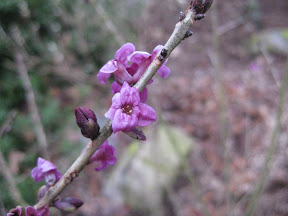
Daphne mezereum


Further along the promenade on the right side at the pathway to the band stage the two Daphne mezereum (February Daphne) are blooming with white and purple flowers. This plant is deciduous so look for small flowers on branches of the small shrubs.


Daphne odora 'Marginata'


The evergreen Daphne odora ‘Marginata’ (Winter Daphne) at the pathway should have open flowers by the weekend if the warm temperatures continue. There will be a sweet scent on the air when that happens.


Helleborus orientalis


So you may be ready for your snack by the time you get to the Fuchsia bed where you will see Helleborus orientalis (Lenten Rose) blooming. (You are in front of the Administration building).


Azara microphylla


Back up a bit and wander a few meters east towards the machine shop to the Azara microphylla and look at the under side of the branches. Under the very small evergreen leaves you will find tiny yellow flowers that have been opening up all week. This is where your nose will smell a different kind of sweet scent on the air.


Each person has their own interpretation on the scent, but most often the survey says it is chocolate or vanilla. If you missed the Camellia reticulata on your last visit you should see it now – the entire bush is covered in big showy pink flowers. Can you find? (Check out the previous garden article for the location.)


Camellia japonica 'Magnioliaflora'


Walk around the east end of the rose garden and follow the front edge of the warehouse toward the lock wall at the end of that planting bed is the Viburnum x bodnantense we featured in the last post--right across from that you will find the Camellia japonica ‘Magnoliaflora’ blooming. It has semi double blush pink flowers and is often referred to as Peach Blossom Camellia.


As you work your way back towards the promenade you can glance out over the lawn and see that the Cherry trees are starting to bloom.


Enjoy your visit.

Sunday, January 17, 2010

Friends of the Ballard Locks Meeting Thursday, January 21, 6:30pm

There will be a meeting of the Friends of the Ballard Locks this Thursday!

We meet at the locks at 6:30pm. Parking is free after 6pm in the main locks lot.

If you'd like to join us, please fill out our volunteer form or drop a line to volunteer-at-friendsoftheballardlocks.org. We'll send you directions to the meeting & make sure you can find us!

Wednesday, January 13, 2010

In Bloom: Something Smells Good in the Locks Gardens

Notes from the Carl S. English, Jr. Botanical Garden for January 2010.

Just back in December before that week of cold weather we had over 20 plants blooming. Some were blooming out of season, but now we are seeing the usual mid winter blooms.

Last Thursday while walking past the Administration Building, a fresh sweet scent was on the air. It took a few minutes to locate the source but we finally did.

Sarcococca

The Sarcococca in bed 305 planted under the Idesia polycarpa (tree #7 on 'World Tour') is currently blooming and sending the sweet smell along the promenade.

Chimonanthus praecox

In bed 318 near the warehouse east of the rose garden the Chimonanthus praecox (Winter Sweet) is opening up its pale yellow flowers. Just above that is Hamamelis japonica (Witch Hazel), which is not quite ready to bloom.

Camellia reticulata

Surprising at this time of the month is the one pink red bloom of the Camellia reticulata that is right up against the same building.

Viburnum x bodnantense

In planting bed 319 the Viburnum x bodnantense on the corner of the building has lots of flowers, though many are starting to fade.

Garrya elliptica 'James Roof' (not the exact one mentioned)

In the north nursery to the right just after the main entrance you can find a nice example of Garrya elliptica, the long catkins hanging down showing why the common name is Silk-tassel bush.

At the top of the stairs from the lock wall to the right of the house in the rockery (bed 119) the Osmanthus heterophyllus (False holly) is just opening its tiny white blooms. The fragrance is weak, but as more flowers open there should be more fragrance wafting on the breeze.

Over the next few weeks we will see more plants starting to bloom. We will keep you posted via this blog.

See Also
The pamphlet "Carl S. English Jr. Botanical Garden World Tour" is available in the Visitor Center.